LEAD MANAGEMENT
What is an ideal customer profile?

By Ganesh Ravi Shankar
Last updated on Jul 2, 2026
Explore this blog to understand what an ideal customer profile is, covering its purpose, importance, building models, and common mistakes, so you can target the right accounts from day one.

Every sales and marketing team eventually asks the same question: who exactly are we selling to? An ideal customer profile answers it. Instead of chasing every lead that comes through the door, an ICP gives your team a clear, data-backed picture of the company most likely to buy, stay, and grow with you. This blog breaks down what an ICP is, why it matters, and how to build one your team will actually use.
What is an ideal customer profile?
ICP stands for ideal customer profile. It's a description of the company, not a person, that gets the most value from what you sell and gives the most value back in return. Think of it as a profile built from real traits: industry, company size, revenue, and the specific problem your product solves for them.
People sometimes confuse an ICP with a buyer persona. They're related but different. A buyer persona describes the individual inside a company, their role, goals, and daily frustrations. An ICP describes the company itself. You need both, but they answer different questions. Your ICP tells you which companies to target. Your persona tells you who to talk to once you're in the door.
What is the purpose of an ICP?
An ICP exists to focus your team's time and budget. Without one, marketing generates leads that don't fit, and sales chases deals that were never going to close. With a clear ICP, every team works from the same definition of a "good" account.
It shapes more than sales calls. Marketing uses it to decide which channels and messages to invest in. Product teams use it to prioritize features. Even customer support benefits, because accounts that match the ICP tend to need less hand-holding and churn less.
Why does an ICP matter?
An ICP matters because chasing the wrong accounts costs real time and money. Every hour a rep spends on a deal that never had a chance to close is an hour not spent on an account that actually fits. Marketing sees the same waste — budget spent attracting leads who never had a reason to buy.
Teams with a clear ICP move faster in the other direction. Sales cycles shorten because reps are already talking to people who feel the pain your product solves. Retention improves too, because customers who match your ICP get real value from what you built, so they stick around and often bring in referrals.
This is also why ICP sits at the center of lead qualification; a strong ICP is exactly what a solid qualification process filters new leads against.
Models to build an ICP for your business
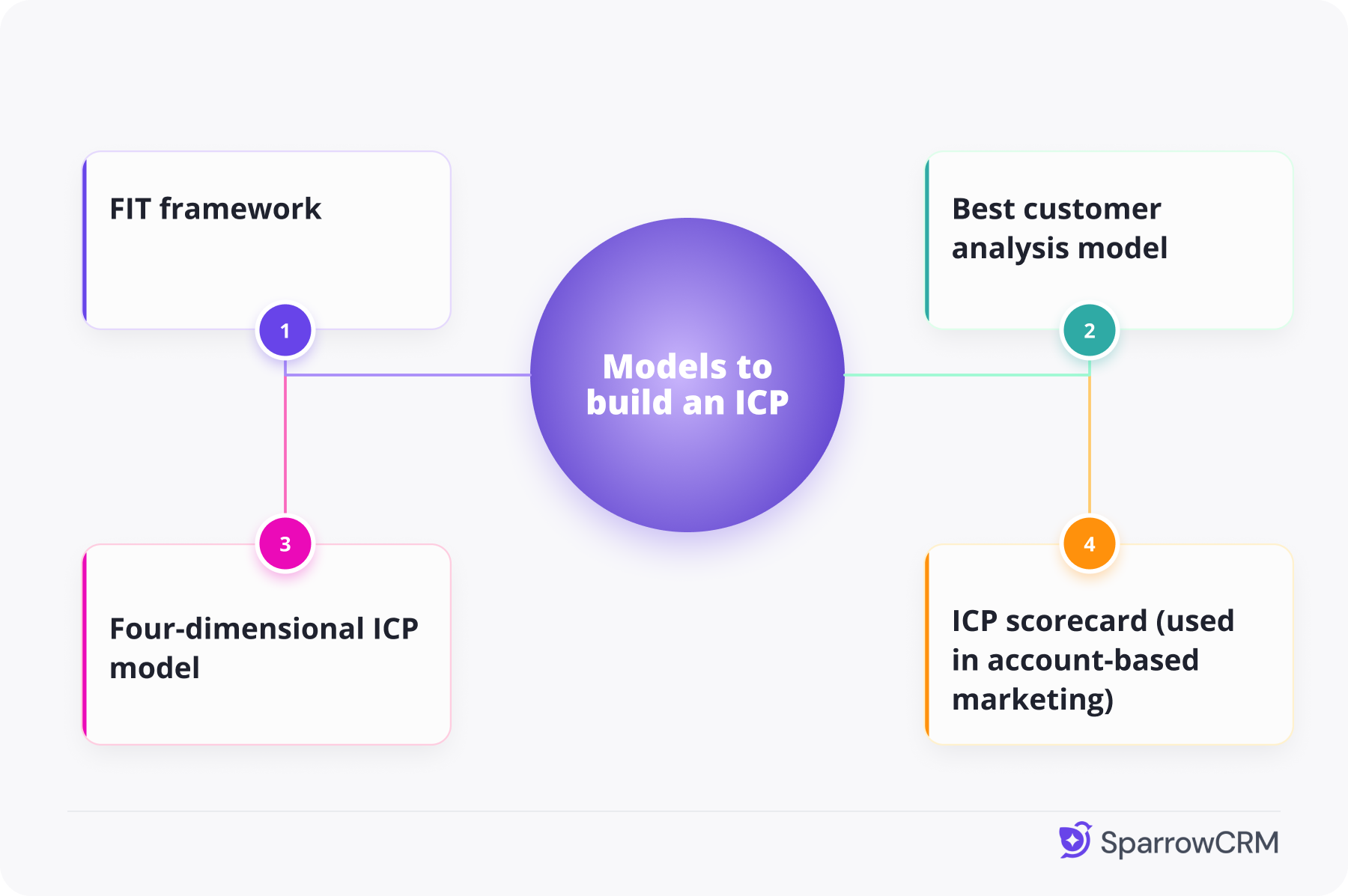
There's no single template for building an ICP, but four models cover most real-world situations. Pick the one that matches how much customer data you already have.
1. FIT framework (simple and practical)
This is the easiest model to put into practice today, especially if you don't have much closed-deal data yet. It looks at three things: firmographics, the pain a prospect is actively trying to solve, and the technology they already use.
Category | Questions to ask |
Firmographics | Industry, employee size, revenue, geography |
Intent/pain | What business problem are they actively trying to solve? |
Technology | What tools do they already use: CRM, ERP, Slack, Salesforce, HubSpot, and so on? |
Example (for SparrowCRM):
- Industry: SaaS, IT services
- Employees: 50–500
- Revenue: $5M–$100M
- Geography: US, UK, India
- Tools used: spreadsheets
- Pain: losing follow-ups, poor sales visibility, scattered customer communication
2. Best customer analysis model (most accurate)
Instead of guessing at traits, this model works backward from the customers you already have. Look for patterns among the accounts with:
- Highest ARR
- Lowest churn
- Fastest sales cycle
- Highest product adoption
- Most referrals
- Lowest support effort
Once you've flagged those accounts, look for what they share: industry, size, how they found you, what they use your product for. Those shared traits become your ICP. This is how most SaaS companies keep refining their ICP as they grow, instead of setting it once and leaving it alone.
3. Four-dimensional ICP model
This model builds a fuller picture across four layers instead of relying on firmographics alone:
- Firmographic: industry, company size, revenue, geography, growth stage
- Technographic: CRM, marketing automation, cloud stack, integrations
- Behavioral: hiring sales reps, expanding into new markets, recently funded, actively searching for a CRM solution
- Needs: main pain point, desired outcome, buying urgency
Combining all four gives a much richer profile than firmographics alone; it tells you not just who to target, but when and why they're likely to buy right now.
4. ICP scorecard (used in account-based marketing)
This model turns your ICP into a number. Assign a weight to each attribute, then score every account against it:
Attribute | Weight |
Right industry | 25 |
Right company size | 20 |
Uses compatible tech | 20 |
Buying trigger | 20 |
Budget fit | 15 |
Accounts scoring 80 or higher become Tier 1 targets, the accounts your best reps go after first. Many revenue teams use a weighted score like this to prioritize outreach instead of treating every lead the same.
Start with the FIT framework if you're just getting started, move to best customer analysis once you have enough closed deals to study, and layer in the four-dimension model or a scorecard once your team needs to prioritize at scale.
Turn Your ICP Into Revenue With SparrowCRM
Examples of ICP
Two quick examples show how specific a good ICP gets.
A project management SaaS company might define its ICP as: mid-market professional services firms, 50 to 250 employees, using at least two other cloud tools, based in North America, with a project lead actively searching for a way to track client work.
A B2B CRM platform aimed at growing sales teams might define its ICP as: SaaS or tech companies with 2 to 50 employees, led by a VP of Sales, Revenue Officer, or founder, currently managing leads in spreadsheets or an outgrown CRM.
Notice neither example is vague. An ICP like "mid-size companies that need better software" doesn't help anyone prioritize anything.
Mistakes to avoid when defining your ICP
- Making it too broad. An ICP that fits half your market isn't a filter; it's a wish list.
- Confusing it with a buyer persona. If your ICP includes a job title and a personality trait, you've built a persona, not an ICP.
- Never revisiting it. Your best-fit customer today may not be your best-fit customer in two years. Review your ICP against real win and loss data at least twice a year.
- Building it without sales input. Marketing can't build an accurate ICP alone; the people talking to prospects every day see patterns a spreadsheet won't show.
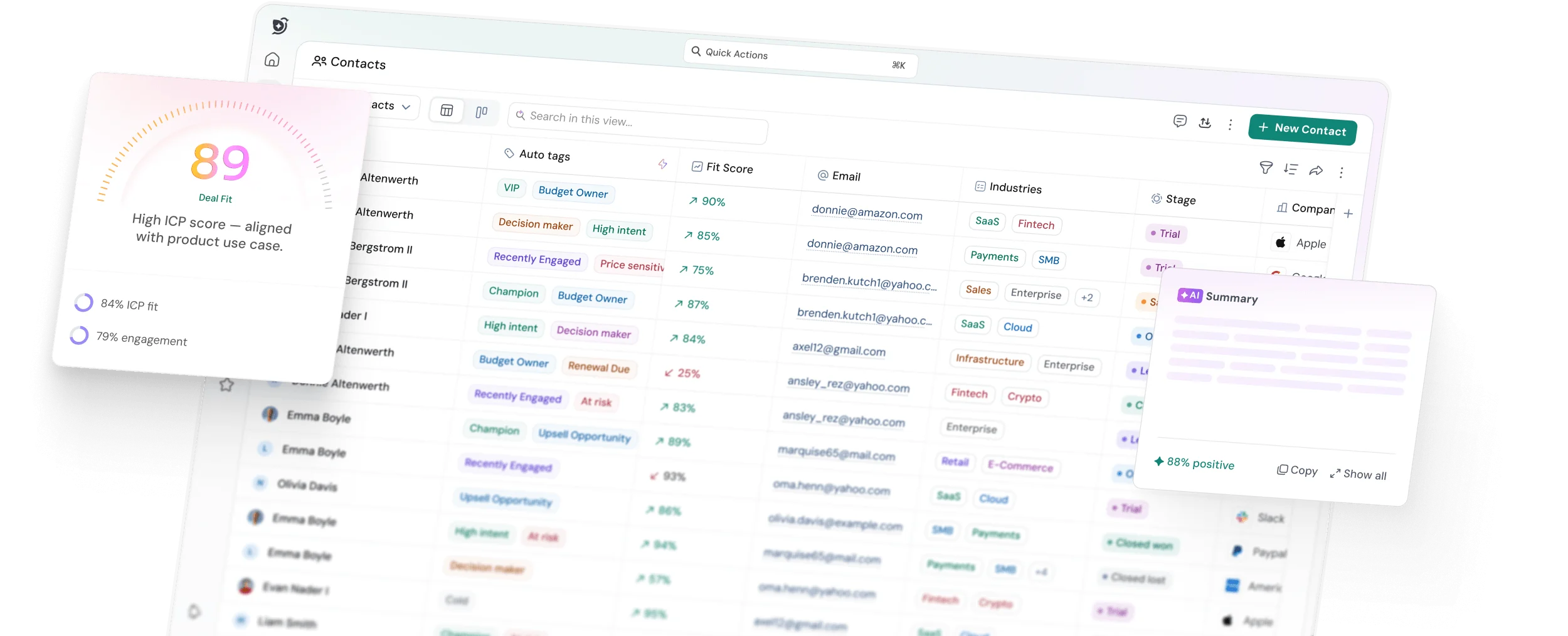
Fixes the mistake of never revisiting your ICP: SparrowCRM's ICP Fit Score automatically scores every contact and company against your criteria, so fit isn't a one-time doc that gathers dust. It updates in real time as your data changes, showing High, Medium, or Low fit at a glance. No criteria set yet? SparrowCRM starts with sensible defaults you can edit anytime.
Final thoughts
An ideal customer profile isn't a one-time document; it's a working filter that should get sharper every quarter. Start with your best current customers, build your ICP from what they actually have in common, and revisit it before it goes stale. Get this right, and every team from marketing to support ends up pointed at the same accounts, for the same reasons.